Showing posts with label ultra running. Show all posts

Thursday, October 29, 2015

5 Reasons People DNF at the Javelina 100 Miler and How to Avoid It (with Wizard of Oz Style!)

Who you callin' cute, sucker?
Post updated/revised:
I originally wrote this post in October of 2015 to put my money where my mouth is (or was). I toe'd the line of the Javelina 100 Miler the following two years (2015 and 2016) in Fountain Hills, Arizona (near Scottsdale, the home of the AZ Fall League's Scottsdale Scorpions, a development team including players from the San Francisco Giants farm/development system, but I digress...). While 2015 was my 21st attempt to run 100 miles (or a little further), it was my first time tackling the cute little pig known as Javelina. No, they aren't really pigs, they are peccaries, which is like a cousin to a pig. I guess some ways this is an interesting parallel because some have been known to say that the Javelina Jundred 100 Miler is "a runnable, fast, good 100 for first timers that is on a relatively easy course." Ohhhhh, boy. That's where the danger begins...

Let's first explore the question of the DNF percentage from 2009-2017 (over 50% who start typically do not finish this race, historically). Why the hell does this "runnable, flat-ish, relatively easy course" have one of the highest DNF rates in ultra running? Some would say that it's the disproportionate amount of first-timers. I would argue that it's not the relative lack of experience that does many in, as I've seen some really experienced 100-mile runners go down here (I am now 2-for-2 at Javelina in spite of two pretty rough years/races). If one doesn't look at what makes this challenge particularly unique, and you expect to suffer less relative to other races, then this is what makes this event so difficult. Here are the starting and finishing stats, and finishing/DNF percentages from the 6 years I crewed and coached athletes for Javelina...

*BEFORE THIS BLOG WAS POSTED, THE SIX YEARS I CREWED/COACHED AT JJ100*
2009 - 250 started / 124 finished (49.6% finished, 50.4% DNF'd) - Sub 24's = 38 (15.2%)
2010 - 263 started / 137 finished (52.1% finished, 47.9% DNF'd) - Sub 24's = 50 (19.0%)
2011 - 339 started / 174 finished (51.3% finished, 48.7% DNF'd) - Sub 24's = 65 (19.2%)
2012 - 364 started / 160 finished (43.9% finished, 56.1% DNF'd) - Sub 24's = 56 (15.4%)
2013 - 377 started / 157 finished (41.6% finished, 58.4% DNF'd) - Sub 24's = 41 (10.1%)
2014 - 511 started / 290 finished (56.8% finished, 43.2% DNF'd) - Sub 24's = 98 (19.2%)

2009-2014 TOTALS:2,104 started / 1,042 finished (49.5% finished, 50.5% DNF'd) - Sub 24's = 348 (16.5%)


2015 JJ100, Lap 2 (old course) - photo by SweetM Images


*AFTER THIS BLOG WAS POSTED, THE TWO YEARS I RAN JJ100*
2015 - 
459 started / 281 finished (61.2% finished, 38.8% DNF'd) - Sub 24's = 113 (24.6%)
2016 - 574 started / 285 finished (49.7% finished, 50.3% DNF'd) - Sub 24's = 93 (16.2%)

*LAST YEAR*
2017 - 534 started / 348 finished (65.2% finished, 34.8% DNF'd) - Sub 24's = 113 (21.2%)

2015-2017 TOTALS:
1,567 started / 914 finished (58.3% finished, 41.7% DNF'd) - Sub 24's = 319 (20.4%)
2009-2017 TOTALS:
3,671 started / 1,956 finished (53.3% finished, 46.7% DNF'd) - Sub 24's = 667 (18.2%)


Having crewed and coached over 30+ athletes who've run Javelina, and now having back-to-back years suffering through it myself, I am here to tell you how I've seen people shoot themselves in the foot. Some of this is general 100-miler stuff, and a few things are unique to Javelina. So, here we go...


5 SIGNIFICANT REASONS PEOPLE DNF AT JAVELINA

#5- How about a little fire, Scarecrow? (not managing the heat... well enough) - this race is super exposed and relatively hot. It is generally not humid, and most certainly Arizona sees typical temps that are ~30 degrees higher at times in the summer. Javelina seems to trend around a high of 80 degrees, give or take 10 degrees. So 90 is a blistering hot year, and 70 is a "cold year". But here's the problem, it's exposed. You never get a respite from the direct sun, unless there's no sun (or you're sitting under a tent, not moving forward on the course). The sun beats down on the trail (and you) relentlessly, and Laps 2, 3, and for some 4 (and 7) are hard on you like it's 10 degrees hotter. It might actually be a few degrees hotter. As the sun bakes the trail throughout the day, the heat emanates off the trail below you and it will hit you a little harder than if you were running in the shade. So, pretend it's 10 degrees hotter, and keep ice in a bandanna around your neck, fill your running cap with ice, and do not drink ice water.

Momentary heat side-track: if you drink ice water in your bottles when that cold water hits the stomach, the body is forced to use energy in order to warm up that liquid inside your body to match that of your body's natural internal temperature. This process will rob your body of the energy it needs to properly process what fluid (and calories and electrolytes) you've ingested. So energy is spent on the regulation of the internal fluid temps, rather than processing new fuel/energy and it is a super big deal as that energy deficit adds up in the heat of the day.

Cold water (or ice) is for your head and neck. Warm or air temp water is for drinking. If you're running, your body is generating more heat (than if you're moving much slower). So during those hot laps (when I've seen some speed up), slow it down a little to help manage your core temps.

#4 - There's no place like home, there's no place like home! (getting too comfortable at the start/finish with family/friends) - this is one of the chief problems with the mental DNF at Javelina, being at the place where all your finishing crap is! And your lovely family! And when you say in the middle of the night, "I don't want to do this anymore, I'm not having any fun" sometimes you have a crew that's thinking, "thank effen goodness, we're so ready to be done too!" 

Know that you pass through JJHQ around Mile 15.5 (one), Mile 31 (two), Mile 46.5 (three), Mile 62 (four), Mile 77.5 (five) and Mile 93 (six), and if you think you'll get through JJHQ excited to leave for another 15.5 miles in the dreaded desert every single time, think again. You're gonna feel the suck at least 2 of those 6 times, possibly more, so you've got to have a plan to get in an out of there efficiently. Don't rush it, you need to get stuff for another 2-5 hours out there. "Be quick, don't hurry" (one of my favorite Coach John Wooden quotes). But unless you're fixing blisters at medical, doing a complete outfit change for the night, there's really no reason to be there for more than 5 minutes. Get out. Don't sit down (except to change shoes, if you must). Keep moving. Get your mental juju back by taking steps towards the finish line.

#3 - Poppies, poppies, poppies. Sleeeeeeeeep! (the curse of naps and mismanaged caffeine) - I would love to dive into the science of why you should try to avoid caffeine during the day when it's hot. But this post is going to get way too long (it's already twice as long as I intended). So let me put it in another way, you want to save caffeine (and other stimulants) for when you actually need them. Your hypothalamus is going to try to power things down in your body so you can sleep (restorative regeneration) while you're still running if you run long enough. So save the inner light for when it gets dark. And once you start using caffeine, you better keep using it or your energy will fall off a cliff. I like to try to keep the stream coming every 25-30 minutes once I start, but at the very least I'm getting it at every aid station once I begin to use it. Also, if you get really, really tired, some get to the start/finish and try to sleep and rationalize when they wake up they'll feel better (and be able to run better). In my experience, this is rarely true. And you wake up in 90 minutes when you planned for 30. And now you're fighting cutoffs. So don't do it. Manage your mind, your stimulants, and keep on keepin' on.

#2 - Ring around the rosy, a pocket full of speed! (getting carried away with pace splits in the first two-three laps) - Okay, so the Wicked Witch of the West said spears, not speed. But hey, if you run too fast your quads, hamstrings, IT bands are all going to feel like the Wicked Witch put a bunch of spears into you. I have witnessed more "speed kills" at this race than every other 100 miler I've been to combined. I've seen runners with a 28+ hour 100 miler PR running around 17-hour pace splits. Just running comfortably, and aerobically is not enough. A marathon race pace is aerobic and comfortable for 20-ish miles! Then you go into ketosis when you've exhausted your glycogen supply and you're fighting cramps and you are metabolically hosed. Marathon pace plus one minute is more like a 50k pace. I don't even recommend running by pace. For those of you not running with a heart rate monitor, it's going to be a little more tricky. If you've never run 100 miles before, you've got to be even more careful and conservative. Think of it this way, around 20% of the nearly 500 race starters ran sub-24 hours last year. Are you typically in the top 20% of the races you finish? Because if you're not, you're pretty bold going out in sub-20 hour pace and rationalizing that you're putting time in the bank. Putting time in the bank is like tying a loaded safe to you so you can run the second half of the race dragging said safe behind you. A sub-20 hour time is around 11:45/mile pace (or faster). Yes, we all factor in stop time (which is generally around a minute per mile or more), so really, we're talking 10:45 average running pace. "But I can't run that slow!" many will exclaim to me. That's what walking up small inclines is for. Or just taking a walk break to lower your heart rate. Running faster than 12 minutes per mile in the second half of the race is actually quite impressive, so try to bring your first half and second half paces closer together so you can be the one passing dozens, or even 100 people in the second half. Now that's a fun race!

#1 - I'll get you my pretty, and your little dog too! (not taking the suffering seriously) - I'm going to break this one into two different categories, the beginner, and the experienced 100 miler...

1st Time 100 Milers - so you've never experienced 100 miles yet? Maybe you've run a few 50 milers or a tough 100k, but this is your first journey into those extra 40-50 miles of pure magic. People tell you it's going to hurt, but there's no context to it. You may have even heard moms who run hundos compare it to childbirth. Kinda freaky, right? But hey, it didn't scare you that much, and here you are! Pitfall #1 is thinking of 100's in a linear or proportional fashion. It doesn't hurt twice as much, nor twice as often as a 50 miler. In some cases, it's worse than that. In others, it's not that much worse pain wise, but you're in that hurt locker for a lot longer. It takes mental stamina, toughness and a willingness to suffer a bit. You really aren't going to know if you're mentally ready until you're in that moment. But what I do is measure the number of hours I've put into training (for me, this time around it's about 250 hours, or 10 hours a week average for the past 25 weeks, I'm rounding off here, but that's a ballpark). Then, when I'm hurting, I tell myself, "this isn't going to hurt like this for the rest of the time, but even if it did, that's only 10 more hours (example), and that's not even 1/20th of my training!" I tell myself to consider others who wish they could be running by my side. My wife just had leg surgery. My buddy Alvin would love to run a loop with me (he's in a wheelchair now). I'm so lucky to be able to hurt this way. I'm so lucky my body is capable of this amazing, freaky endurance. I keep telling myself these things to re-frame the pain. And believe me it helps if you commit to it. So when it really hurts, the worse it is, the more proud you're going to be of finishing. I've heard it said very eloquently that "finishing 100 milers hurts for a week. DNF'ing 100 milers hurts for at least a year." So, get along little doggie...

Experienced 100 Milers - the main pitfall with an experienced hundred miler at Javelina is you've probably run much harder courses than this. You've maybe even run on hotter days than this. It's dangerous to think that because the course isn't as hard, and the heat isn't as high, that you'll suffer less. Then, when you suffer more, you're ill equipped to handle it psychologically. Here's the rub: this course has more running. The more you run, generally speaking, the more it's going to hurt. I ran 6 of these things last summer, and Vermont (while my fastest race last summer) was the race I was in the most disrepair at the finish line. My feet were wrecked. I was in the medical tent for a bit. Running more is really rough, especially for those of you who are used to mountain races when you get your hiking uphill break, then downhill feels like low-effort since gravity is doing the work. Maybe you don't feel that way, but if you want to run your fastest time at this distance, you at least have to be willing to hurt more (and for a longer duration) than you have before. Then, if you don't, it's a mental boost. Gravy, my friends.
Follow the Pemberton Trail, follow the Pemberton Trail... follow, follow, follow, follow...

I have a lot more to say about running 100 milers, but I'll save it for another time. I hope these 5 pitfalls help you overcome the Wicked Witch of the West at McDowell Mountain Park. I'm rooting for all who toe the line at Javelina. I want a bunch of people to high five and run with in that second half. And if you see me sitting down, come kick my ass and tell me to get back out there (unless I'm being carted off on a stretcher, then let medical do their job)...

2016 JJ100 Lap 3 at Jackass Junction - photo by SweetM Images

Jappy Jalloween, Jeveryone!

Wednesday, February 05, 2014

Heavy Lifting for the Runners' Mind - My Film List for the Mental Game

I'm fresh off of my second 50 mile DNF (both coming the first weekend in February on my sophomore run of a course in my Santa Monica Mountains backyard).  I know that my body didn't respond, part of which could have been just having an off day, and part of it definitely being undertrained.  I don't regret being undertrained, as my focus is on Summer 2014, and I now know there's no way I'm peaking too early.  But that's also my self-justification for not doing enough of the necessary grunt work, laying the foundation brick-by-brick.  I'm out the door for a run in a few.  One day at a time.  All that said, until my body failed me, my mind was solid in spite of a great number of problems out there.  That is one of my take-aways.  I have 4 months (or 17 weeks) to get in peak 100 mile shape.  I know my mind is ahead of that curve.

"Like success, failure is many things to many people.  With a positive mental attitude, failure is a learning experience, a rung on the ladder, a plateau at which to get your thoughts in order and prepare to try again."
-W. Clement Stone


Get to work on your mental game.

It seems like a general and broad-sweeping stroke.  But here's what I mean when I say that.  Workouts and physical fitness are only about half the story when it comes to setting new personal standards in speed or distance (or both).  You must develop the mental makeup so that you don't mentally breakdown.  There are a lot of ways to get there, and generally speaking, a coach will implement these things into your training runs (sometimes overtly and often times, like in my case, covertly).  You can always improve your mental game.  I love reading inspiring books and watching inspiring films (they absolutely do not need to be about running to be good for your mental game).

Here's a list of a few movies that really stoke my mental fire.  What I mean by that?  I cry tears of joy, tears of anguish and tears of being moved by the human spirit each and every time I watch them:


THE DISTANCE OF TRUTH
Ferg Hawke running through the valley of death
MY TAKE: A searing documentary about the BADWATER 135 Ultramarathon (aka the World's Toughest Footrace).  I've crewed/paced this race 3 times now, and I'll be stoked to be help another friend get this done this year, even though I can't attend the race.

SYNOPSIS: This 90-min documentary features Canadian Ferg Hawke as well as Scott Jurek, Dr. Ben Jones, Charlie Engle, Ray Zahab, Monica Scholz, Pam Reed, Dean Karnazes, Marshal Ulrich and Mike Sweeney as they experience the BADWATER Ultramarathon. Footage from both the 2005 and 2006 races are included as well as interviews, course profile, blister care and finish line drama. The race itself is broken into the six legs and even after 90 miles three athletes are separated by only about a mile and a half. The finish is amazing with records falling and 11 athletes are shown crossing the line.

WHY YOU SHOULD WATCH THIS: Because if you're reading one of my blogs, let's be honest, you're already pretty silly, and there isn't much sillier than running 135-miles through Death Valley in the peak of summer heat.  In case of invisible self-limiting barriers, break glass (ceiling).  This movie will leave you without valid excuses.

QUOTE I LOVE: "If you run long enough, something is bound to happen."


RUDY
How many setbacks must one endure to realize an impossible dream?
MY TAKE: It is slow at points, but then again so is life.  If you patiently entrench yourself in this story, you'll feel Rudy's passion, his devastating lows and triumphant over-coming of long-shot odds.  I love this movie.

SYNOPSIS: Rudy has always been told that he was too small to play college football. But he is determined to overcome the odds and fulfill his dream of playing for Notre Dame.

WHY YOU SHOULD WATCH THIS: You don't have to like college football, this is a movie about having a tenacious spirit and chasing impossible dreams.

QUOTE I LOVE: "In this life, you don't have to prove nothin' to nobody but yourself."


CHARIOTS OF FIRE
What inspires you to run fast?  Old dares do it for me.
MY TAKE: Also takes some time to build into things, but each scene is vital in a really well woven piece.  It examines the why of two Olympic runners.  One runs to "feel God's pleasure" and another runs from an absolute terror of being second best.  Love vs Fear.  A perfect examination of life.

SYNOPSIS: The story of two British track athletes, one a determined Jew, and the other a devout Christian who compete in the 1924 Olympics.

WHY YOU SHOULD WATCH THIS: It doesn't matter why you run.  It matters that you run (see: exercise).  This movie will have you examining why you run and when you run and may enable you to get the most out of your mental game by determining your mental outlook.

QUOTE I LOVE: "I've known the fear of losing but now I am almost too frightened to win."


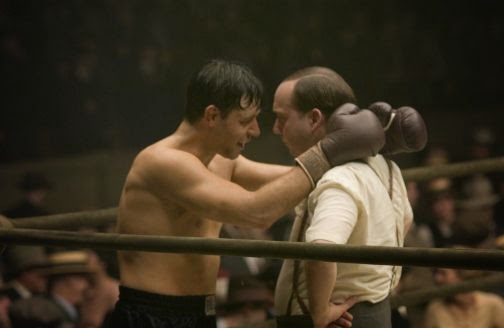
CINDERELLA MAN
Buoyed by great performances and Academy Award nom for Giamatti
MY TAKE: One of my 2-3 favorite films of all time (the other 2 are Shawshank Redemption and Crash).  I love this movie for so many reasons.  It will make you feel.

SYNOPSIS: Based on the true story of fighter Jim Braddock, who in Depression-era New York enters the boxing ring out of desperation to feed his family. He becomes a common folk hero as he battles his way up the ranks, vaulting from broken-down ex-boxer to living legend with a string of amazing upsets to his credit. As word of the scrappy underdog spreads, entire families stay glued to their radios, cheering, praying and experiencing his victories as their own. Their devotion reaches fever pitch when Braddock faces heavyweight champ Max Baer. That night, Braddock's dignity, courage and determination gives hope to a nation and earns him the nickname of Cinderella Man.

WHY YOU SHOULD WATCH THIS: You don't have to like boxing, nor be a fan of Russell Crowe or Renee Zellweger.  This movie is about choosing to get back up after getting knocked down (no matter how many times you hit the mat).  Boxing may be a perfect analogy for life in the courage to get back up off the mat when life is punching you in the face.  Give in to this movie.

QUOTE I LOVE: "For two hundred and fifty dollars I would fight your wife... and your grandmother, at the same time." 


UNBREAKABLE: THE WESTERN STATES 100
http://www.ws100film.com/
Photo by Luis Escobar, RD of Born to Run Ultras and Red Rock
MY TAKE: This is JB Benna's masterful weaving of a story about living outside the box, challenging one's perceived limits and going into that unknown void and seeing what part of you comes back from it.  This movie inspires me for many different reasons.

SYNOPSIS: This is the story of the 2010 competitive men's race in the granddaddy of trail ultra runs, the Western States 100.  In addition to following 4 of the top ultra runners in the world, it tells much of the story of how the Western States Endurance Run came into being.

WHY YOU SHOULD WATCH THIS: Because everyone faces their mental breaking point in a race that means a lot to us.  Sometimes our expectations, our goals, or even the conditions in the race can break us.  Sometimes it's our competition.  But watch how these competitors respond to being broken, and what they do in the face of it.  Warning: it might make you want to run Western States, or 100 miles, or both.

QUOTE I LOVE: "I can still take one more step. And so at that point I decided to take one more step until I could not longer take one more step." 


HONORABLE MENTION - Other Films I Love for the Mental Game
The Fighter, Finding Nemo, Rocky, 300, Rocky IV, and many more...


THE BOTTOM LINE
We could all use a little (more) work on our mental game.  These 6 movie-films will help you with that (and I threw in 5 more on the HM list a few sentences above this).  Hope you enjoy them as much as I do.  Let me know what you think, especially if you see them now (with new perspective).


If you have other films you love watching, post a comment below and let us know what films help you with your mental game!

Wednesday, January 29, 2014

10 Ways Running 100 Miles Over Mountains is like a Weekend in VEGAS!

I saw Little Miss Sunshine (yes, for the first time) a couple nights ago.  It's the second film I've seen in the past few months with a speaker who doesn't live his message (Donnie Darko was the other).  I know I'm not Jim Cunningham (Patrick Swayze's charater) nor am I Richard Hoover (although I'm not too far off of Richard Hoover's "don't stop, no matter what the circumstances dictate" mantra), but sometimes I worry about losing my audience being overtly content & happy many days.  Henceforth, I'm going to work to integrate this blog into three types of posts:

1- life lessons (stemming from the adversity I've faced)
2- adventurous stories (tall tales, many running related)
3- silly perspective posts (every so often to lighten the mood)

It's going to be a unique soup of posts, but there you have it.  I'm all over the place sometimes, so this will better represent me too.  Without further ado...


10 WAYS RUNNING 100 MILES OVER MOUNTAINS IS LIKE A WEEKEND IN VEGAS!
10. Some people stop in the light of day, but many will be pulling an all nighter.


9. Waking up the morning after, we all ask ourselves why we just did that to ourselves.
"Never, ever again!  This time I mean it!  For reals!"


8. The longer we keep going, the less we seem to care when we throw up on a friend, on our shoes or in one of our own bags (shout out to Puck!).


7. Friends always make it more fun.  They can also validate and legitimize your stories of what really happened.


6. Aid station hopping can be just as fun as club/bar hopping.


5. After a crazy night, all we want to do the next day is lounge by the pool.


4. You're either going to have a good time, a great horror story, or both. Chances are you'll see some $#!^ you've never seen before.


3. The wetter you get, often times, the better the story is... TWSS?


2. You might have a crazy naked dude *chase you with a crowbar.
*In the 100, you're probably just hallucinating. Probably.

1. the cougars love the night life!
(Photo Credit: Steve Winter/National Geographic)


BONUS: you might end up passing out on the bathroom floor in either.

Photo Credit: Coach Jen Vogel - Instagram.com/UltraIronJen 

BONUS: in both, there's always a photo or two we hope doesn't end up on social media!
What is Chamoun doing here???
Don't worry Chamoun, this isn't my best look either.


What have you experienced in a 100 miler (or Vegas) that you can relate to both activities!?  Hope you enjoyed the list...

Monday, January 27, 2014

Overemphasis on Training in 100 Mile Trail Run Prep - Angeles Crest 100 Lessons 2006-2014

"Nothing on Earth can stop the man with the right mental attitude from achieving his goal; nothing on Earth can help the man with the wrong mental attitude."
-Thomas Jefferson


BAD ATTITUDE 101 - Angeles Crest 2006 at Eagle's Roost
I am not the most qualified person to be telling you how to train for a 100 mile mountain race.  I am not fast, and am lucky to crack the Top 25 of a deep race field.  I don't even log high mileage all that often (number of weeks in 2013 over 70 miles = 6, number of 100+ mile weeks not including a week with a 100 mile race in 2013 = 0).  I have even coached runners for Angeles Crest (and various other 100 milers) that have failed to finish their respective races (don't ask about my Dave 'Comet' Chan story, please).  There are many more qualified AC experts out there.

All that aside, you have found this blog entry (so pull up a chair and stay a moment).  I'm here to present a perspective that I've been chewing on for a few years now, something I've struggled to fully grasp or articulate, but it crystallized in a conversation with a fellow student of 100 milers, and someone far more credible than I (who will likely blog on this very topic in the near future *nudge, nudge* ).

Okay, I lied, look how pretty I am here.
Running 100 miles (or "migrating 100 miles", to quote my fellow blogger Ashley) in a single day is a brutal challenge.  It tests us physically and psychologically, sometimes to the very fabric of our being.  It strips us of all excess energy, to the point where all facades fall away and we're left raw and emotive, just a primal being often going off of pure grit and gut instinct.  In my case this is often not a pretty sight.  For some of my closest friends it is a time to fully enjoy the show, as I behave in ways I might not want to be seen behaving at any other time (at least publicly).  I might throw a tantrum or two. I sometimes complain. I often puke. Sometimes I even cry like a baby.  And hold on to your seat for this one, there are instances I am dead quiet for extended periods of time.  *GASP!*

Chamoun leads Gleason up Williamson - AC 2012
I'd estimate in all of the training programs I've personally executed over the last 12 years preparing for marathons and longer races, my two most dedicated, high mileage, most focused training programs were in 2006 training for my first Angeles Crest 100 Miler and in 2008/2009 training for the Western States 100.  Interestingly enough, until I tried to run my 2nd hundred miler in a 2 week period (AC/Leadville back-to-back in 2013), both AC '06 and States '09 were my two most difficult 100 milers (see: most frequent low points, most death marching, and highest cumulative time in aid stations).  I don't care if you finish these races in 18 hours (or faster) or 30 hours, to me, speed is relative and it is an impressive feat of courage (and foolishness) to even toe the line of one of these monster mountain endurance runs.  Conversely, two races I probably had the least consistent training for, AC '13 and Rocky Raccoon '10, I had some of my better times.  Yes, those are wildly different events. I suffered tremendously at AC last year due to my lack of training (and other influencing factors), but I ran times I consider to be good for me at those two events (with less than ideal training).  This had me examining some of the finer points of 100 mile race prep with many friends of mine who have a depth of personal experience at 100 miles.  Leading up to a conversation between Pam, Kate and I, about interesting and notable performances on less than ideal training earlier this week.


As far as I'm concerned, this hypothesis could apply to the Pam Smith's (see: runners who win races) just as much as it does athletes who are fighting cutoffs for a high percentage of the race, and everyone in between.  Granted, the athlete who has less than ideal training might not be competitive for a win in today's deeper fields of competitors since most elites I've read up on now consider every element of what I'm about to talk to you about.

DISCLAIMER: I do not intend to insinuate that an athlete does not have to train very much to finish a 100 mile race.  Training up to this distance is essential.  Doing so intelligently, patiently (over an extended period of time), and consistently over race specific terrain is ideal.  The goal should be arriving at the starting line healthy, rather than "how many times can I run 100 miles in my weekly training" no matter the consequences.

HYPOTHESIS:  a great many athletes, especially first timers, place a dramatic overemphasis on training in prep for a 100 mile mountain race

To say this another way: many of us focus so much on cumulative weekly miles, running fast, running up steep terrain, tempo runs, speed work, stair repeats, strength training and getting physically ready that we overlook some pretty essential aspects of 100 mile racing (not to say we're all racing, but 100 miles in an event is distinct from just going out to do 100 miles on your own with no time constraints).

What often gets overlooked when training is overemphasized:
Checklists of everything I could possibly anticipate: AC 2012 edition
*Nutrition - both day-to-day diet influencing metabolic efficiency and effective race day nutrition strategies
*Mental Strategies - conditioning ourselves to think in a way that empowers and inspires our best effort, learning to deal with the inevitable and often devastating lows of a 100 mile run.  This can include mantras, anticipation of difficulty and acceptance of certain problematic scenarios.
*Hydration/Electrolyte Replenishment - there are many schools of thought here, but often athletes don't even consider how little (or how much) they're drinking or how an electrolyte imbalance might affect their race
*Pacing Plan vs Exertion Plan - you might think to yourself here, "nope, I always have a pacing plan" and that's one of my key points: we are often more focused on some target race time than actually adjusting to the effort/exertion level that is appropriate at that moment based on the signals our body is sending us, which can be greatly affected by conditions (heat, altitude, wind, terrain, humidity, etc.).  This doesn't just mean running too fast, it's sometimes being too conservative.
*Attitude - I hold this one slightly distinct from "mental strategies" although it is closely related.  A positive mentality can sometimes help us look at the same (sometimes ugly) circumstances and instead of panicking or having an emotional breakdown, we can smile and laugh about it.

"Do as I say, not as I do." -  IPA & a donut???
I'm the last person who can tell you what you should be doing for nutrition, but for many athletes, it seems to be almost an afterthought.  Fueling strategies implemented on race day aren't tried-and-true for most.  Sometimes, athletes that have something they've practiced a ton in training goes haywire on race day because of aid station grazing (those candies and cookies look great, I'll have a couple).

Hydration and electrolyte replacement is really personal.  There are some diametrically opposed schools of thought here on how much one should drink and whether one should supplement with electrolytes or not.  Again, if you've given no thought to it, it's just guesswork.  It's amazing that so many athletes spend a year planning to run 100 miles, pouring hours into physical training each week, many more hours just thinking about it, without consideration for anything specific here.

Pacing plans: here's the thing, if you are seeking to finish your first 100 mile race, finishing will be a PR.  Some athletes get so caught up in buckling, going for sub-24's, and completely ignoring the redline signals because of pace splits for a goal time that they sacrifice the finish.  And it has proven to be a grotesque oxymoron for me (and dozens of the athletes I train) that when I focus on everything but my splits, I run my fastest time.  When I focus on my time splits, I fall off them pretty quickly and then have to deal with my negative emotions around that early failure.

"Attitude is a little thing that makes a big difference."
-Winston Churchill


Hurting: Mile 52 at AC in 2011. Attitude shift necessary.
Attitude/Mentality: I remember a few years back being too sick to start the Lake Sonoma 50 Miler, on race day I ended up working race check in and helping build the finish line area.  I got to cheer a few Coyotes and a few other friends across the finish line.  I remember one girl in particular who finished mid-pack and threw a tantrum to her friends, "That was the worst day of my life!" she sobbed.  I sat there awestruck.  Wait, didn't you just finish 50 miles?  What about the people still out there, behind you?  What about the people who DNF'd today?  I will never know this girl's name, but she taught me an amazing lesson that day: embrace the hurt locker.  I went on to Angeles Crest that summer (four months later) and every time I felt miserable, I thought to myself "I'm still moving forward at a decent clip, it could be worse, I'm so grateful to be out here doing this..." and it changed my race.  Without very much race specific training that summer, I ran my fastest AC100 time.  A huge part of that was my perspective shifting.  I put a lot of thought into it beforehand.  How am I going to feel out there?  Probably pretty crappy at some point, but that's what I signed up for.

In summary, there are so many pieces to traveling 100 miles on foot, in a single go.  Training may be a key piece of that, but if you don't consider every other piece, you might just be throwing a lot of that training down the drain.

Another parting shot, a clip of the conversation between Pam, Kate and I:
Pam - "So, how fast do you have to run to go sub-24 in 100 miles?"
JDF - "You gotta run 12-13 minute miles, depending on how much time is wasted in aid. Overall 14:30-ish average."
Pam - "Right. So really, how fit does one have to be to maintain 12-13 minute pace?"
JDF - "Depends on the course, I guess?"
Pam - "Sure, but don't you think it's not often the pace that sabotages one's sub-24 goal, but rather, poor nutrition plans, sour stomachs, and not being ready for the low points (mentally)?"
JDF - "Interesting point, Pam..."
Mr. & Mrs. Smith (photobomb by yours truly)
There's a good chance you'll see Pam on the starting line at Angeles Crest this year with a personal vendetta against AC.  I met Pam in 2010 at AC, at Mile 42.  She was trying to drop out and her husband Mac persuaded me to convince Pam to continue.  So she dropped out at the first aid station that was crew inaccessible.  Coincidentally, it was the aid station where I branded myself with my first ever DNF too, Mile 49, the Mt. Hillyer checkpoint.  Whether there in 2014 or not, I'm betting on Pam to finish her next AC...

My Angeles Crest 100 History in finishing (or DNF) photos:


2006 - Finish, 26:27
2007 - DNF at Mile 49

2011 - Finish,   23:51  (first AC silver)

2012 - Finish, 22:38
2013 - Finish, 23:39
2014 - ????
No idea what this year holds in store, but I know Angeles Crest will hypothetically be my 4th 100 mile race inside of 2 months (June 7 - August 2).  I'm ready to be schooled again by one of my favorite mountain ranges anywhere... and I'll be hitting the starting line leaving no stone unturned...

Friday, September 13, 2013

100 Mile Run Double aka Angeles Lead - Biting off more than my BIG mouth can chew

"It's very hard in the beginning to understand that the whole idea is not to beat the other runners. Eventually you learn that the competition is against the little voice inside you that wants you to quit."
-George Sheehan

Standing among legends (from L to R): Tomo (5th), Tom (2x winner, 9x finisher), Jorge (4x winner), Jussi (2x winner, 26x finisher!!!), me (nice eyes JD), Dom (2x winner)

 ANGELES LEAD:
What I Learned Attempting to Run 2 Mountain Hundos with 13 Days Recovery

LESSON* LIST
A- Rest/Recovery are more important than most runners know/practice
B- Sleep, very specifically the week of, is essential to peak performance
C- Pain is an emotion, and often times, it's not based in reality (Embracing Pain: pain sensation and pain perception are different things)
D- Inspiration is a fire, the more logs you throw on the fire (i.e. the more people/stories you've been inspired by), the more fuel you have to burn that fire hotter and longer
E- the people of Wrightwood, CA and Leadville, CO are amazing
F- there are many challenges within a 100-mile endurance run, especially over mountains, and at each event they are unique to that location, and unique to each individual taking that event on
G- Everything you do in prep counts: including (but not limited to) lifestyle modification (eating healthy, drinking less alcohol, supplementing, etc.), strength training, stretching, cross training, heat training, sleeping in an altitude tent, mental prep, etc.
H- We may be able to complete amazing things alone, but with the love and support of friends, family (for me, specifically my amazing wife Kate), not only can we complete them with more fun/enjoyment, but the lows are less sustained because people help pick you up (figuratively, and sometimes literally)
*Learned many of these lessons previously, and some were reinforced these last few weeks
The Pacers/Demons (Andy, Chad) and Crew/Angels (Kate, Chan Chan, Renee) at Angeles Crest

To get to the heart of the matter, I was looking for my next stretch goal.  A stretch goal is something that you CAN NOT DO today, that might take 1-5 years (or sometimes longer) of physical and mental prep to complete, and upon your completion of this type of challenge it will surprise even you and you'd be unrecognizable to your former self upon completion.


Photo by Luis Escobar, BW135 2010
Stretch goals (in the athletic realm) for me over the past 10+ years have included running the Boston Marathon (dreamed up in 1999, completed the first time in April of 2005), running a 100 mile mountain race (dreamed up in May of 2005, completed the first time in September of 2006) and then finishing the BADWATER 135 (dream/nightmare in 2005, completed in July of 2010).  Since BADWATER I have thought about many athletic stretch goals, but have been more focused on career and family stretch goals (presently: writing my first book, engaging in more keynote and motivational speeches on the career side, getting a dog aka Spirit two years ago, now working on the first Freeman baby... stay tuned there).

I'm not going to declare the last 2-3 years an 'athletic malaise' phase as I continued to train for and compete in many races of varied distance and terrain.  Thus far in 2013, I DNF'd my first race shorter than 100 miles (Ray Miller 50 Miler). Then we (Team Coyote) won the inaugural BADWATER: Salton Sea team race (3 runners run side-by-side for 81 miles) from Salton City, CA through the Anza-Borrego Desert, then up to the peak of Palomar Mountain in Eastern San Diego County.  Next I looked forward to my annual 'home hundo', the Angeles Crest 100 Miler (in early August).  As I geared up for my focal point 'A race', I was offered an opportunity to run the Leadville Trail 100 Mile Run with one of the sponsors for that race: HERBALIFE.  Since Leadville was on my Top 5 bucket list for 100 milers (a bucket list that includes Mt. Fuji, Wasatch, Vermont and San Diego), it was an opportunity that I could not afford to pass up, even though Leadville happened to fall 13 days after Angeles Crest completed.  There was indeed a reason behind this level of pure masochism: my next athletic stretch goal.


Team HERBALIFE and some Coyotes at the Leadville Trail 100 Mile RUN
THE LAST GREAT RACE is a SIX one-hundred mile trail race series spanning 15 weekends, with a 100 miler every 2-3 weeks during that span.  This is something I've been dreaming about and pondering the feasibility of since 2007 when I watched a buddy (Andy Kumeda) take it on.  The Last Great Race is ALL of the Original 6 trail 100 milers in the US (the birthplace of 100 mile mountain running) in the same calendar year (from early June to early September).  Old Dominion, Western States (3 weeks after OD), Vermont (20 days after WS), Angeles Crest (2 weeks after VT), Leadville (13 days after AC), and for a grand finale Wasatch (20 days after LT).  The catch?  I've gotta find a way into Western States, where I'm 0-for-6 in the random selection lottery.  There are 5 ways to get in, which I'll rank by the number of entries that go that way.


I have GREAT LUCK in many areas. WS lottery is NOT one of them.
WESTERN STATES 100 - Entry Process
1- THE LOTTERY - approximately 250 entries each year (around 2,000 applicants the last few years)
*telling elementry school kids about my WS100 Silver Buckle dream and my luck with the lottery
2- ELITE QUALIFICATION - 20 entries from the Top 10 men and Top 10 women from last year's Western States (aka States), and prospectively another 2 men and 2 women from each Montrail Ultra Cup race 50 miles or longer in distance, which could account for another 36 entries, but often there are repeat names in the Top 3 at the MUC races
3- AID STATION SELECTION - I've never worked an aid station, so one of these 20-24 slots isn't available to me
4- SPONSOR RUNNERS - 1 per specially designated sponsor, again, not likely a realistic option
5- RAFFLE WINNERS - somewhere between 5-10 of these a year, from 2 raffles happening at lottery weekend in December and at States the weekend of the race (a boy can dream...)


My desire to run Western States 100 again: UNBREAKABLE
One needs to also apply for the Wasatch lottery, however, upon gaining entry to Western States, Wasatch has 'The Grand Slam of Ultrarunning(tm)' clause which states, IF you are denied entry through their lottery, one simply needs to complete States in June, Vermont in July and Leadville in August and you'll backdoor it into Wasatch (provided you've registered for the Grand Slam, which I learned this week is mutually exclusive from the Last Great Race entry/entity).  One needs to be diligent to sign up for Angeles Crest and Vermont quickly, then make sure not to miss the window for Leadville entry and last, but not least sign up for Old Dominion.  Heck, HALF of completing the Last Great Race challenge is getting into all six races and showing up at the starting line.  Logistics for 6 race trips in less than 3.5 months seems daunting, in and of itself.  Then there's the training and prep leading into it.  Recovery in between.

So... TLGR was a very large part of why I accepted an entry into Leadville this year (again, thank you to HERBALIFE for believing in me and inviting me to take part, with a specific shout out to John Heiss and Eric Sammuli for the pre-trip, pre-race and on course support).


100 miles over mountains will sometimes lay you out
Prior to 2013, in the previous 7 years, I had never put 2 of these monsters within 2 months of each other, so within 2 weeks was gonna be a bit CRAY-GEE-TOWN.  I realized that, in advance.  Stretch goals are supposed to stretch the mind (and sometimes the body too).  I made some dramatic changes, including but not limited to:
*hired a strength trainer, the one-and-only June Caseria Johnson, and met with her 1-3 times a week to build core strength, balance out my weaknesses and actually stretch for once
*scheduled 5 deep tissue sports massages with Scott Amiss
*scheduled 2 ART and chiropractic sessions with Chris Tosh
*cut out beer and whisky for the better part of 2-3 months (cheating twice at BADWATER while crewing Jay Smithberger)
Pacing Jay at BADWATER, NO beer/whisky in my water bottle... OR is there???
*upped the amount of greens, cold pressed juices, healthy smoothies/shakes I was consuming
*started consuming more vitamins and recovery supplements (see: amino acids, healthy fatty-oils, etc.), the most key of which was HERBALIFE 24's Rebuild: Endurance shake/drink powder
*upped the amount of sleep I was getting by an average 60-90 min per night (adding 7-10 extra hours every week)
*acquired an altitude generator and tent, used, from my good buddy Peter, to get some altitude acclimation for 4 weeks prior to Angeles Crest and 6 weeks prior to Leadville (my real concern was Leadville)
*started meditating more, and at the same time NOT fixate on the challenge of things too much
I considered each piece of this essential to taking this 2 race challenge on.  Furthermore, this test was to consider whether the investment of time/resources/finances was viable for the Last Great Race.  Enough set up, already. Many of you want to hear about the races themselves...


ANGELES CREST 100 Miler - 2013
My fifth 'AC.'  2006=26:27, 2007=DNF (at Mile 49), 2011: 23:51, 2012: 22:38
Seven's Heaven - the Awesome AC Angels
Spirit is ALWAYS ready to race.
This year I'm #7.  A lucky number.  7th Heaven?  Planning to run sub-22 hours and IGNORE that I was to run Leadville a couple weeks later.  My crew (above: Chan Chan, Kate, Renee, and Sarah) all wore 'Seven's Heaven' shirts, and my pacers (Chad, Gareth and Andy) all donned 'Seven's HELL' tanks.  The Monday before, like a dumbass, I raced Spirit (our athletic dog) through our side alleyway and tripped over a staircase having one of the most violent falls of my life.  Initially thought I fractured my hip.  Kate thought I knocked myself out.  Somehow I ended up with scrapes on both sides of my left hand, my left shoulder (the primary impact point), hip and chest.  I jammed my right leg on the the trip.  More on that later.


Mile 14, beginning the climb up Mt. Baden-Powell
The race starts and I'm in great spirits.  The cuts on my shoulder and left hand are oozing and troublesome, but I chalk it up as a minor annoyance and resolve to ignore it until after the race (note to future self: don't do that again, one month later the wounds have become discolored skin/scars).  Somewhere around Mile 20, descending into Islip Saddle, I feel my right hip flexor isn't right.  My hip flexors have been an issue on and off for a few years, starting with the Oil Creek 100 in 2010 (my last DNF at the 100-mile distance).  Mildly concerning, but nothing to panic about yet.  5-6 miles later, it's bothering me a lot more and I start bitching about it at nearly every aid station (Kate commented I set a personal best for complaints in a 100 mile race, which surprised me a little bit later).  On my way up and over the next mountain, Mt. Williamson (peak #3 of 8 in this race), my stomach starts giving me trouble.  I'm 5 hours, 30 minutes into the day, and stomach challenges inside of the first 6 hours are also not new to me in an ultra distance race.


Eagles Roost (Mile 30) Damage Control
I come into Eagles Roost (my least favorite aid station in ANY race, of ANY distance, ANYWHERE) and I'm battling the demons already.  I come into the parking lot favoring one leg, moving pretty slowly and ask for a foam roller, figuring I'll try to roll out my right piriformis and get some alternative calories in (see: Coke-a-Cola).  My ANGELS mercifully kick me out of the checkpoint and sent me down the road with more ice, fluids and calories.  I Baatan death marched for a while, but as the angels drove by on the 2-Hwy as I walked up it, my head hung low, they yelled some really encouraging words and I began to run again.  As I carved my way back into Cooper Canyon, I began another death march from the base of the canyon up to Cloudburst Summit, which is now about 1 mile longer than it was 2 years ago, as we take a part of the older AC100 course up the PCT.  This didn't help my mood much.  I tried to be encouraging to the many people passing me in the canyon, on the flatter sections of the PCT as I continued my crawl out of the place where many good feelings at AC go to die.  I knew the running would hypothetically get better atop Cloudburst, as it was about 5 miles downhill to the next aid station.  I continued to hydrate and eat as best I could.


Chad and I walking outta Chilao at Mile 53...
Mile 38 to 53 were a bit of a blur.  It was hot, sections rolled down, then up, then down again.  I moved alright, hiked a bit, ran some downhills, and came into the figurative midway point at Angeles Crest (Chilao Flats checkpoint) at Mile 53, ready to pick up my first pacer, Chad.  Chad was lined up to pace me at Angeles Crest in 2007, the year I dropped out of AC one aid station prior to this, earning my first lifetime DNF at any distance.  While I was stoked to pick Chad up, I walked nearly every step of the 6.5-7 miles he was with me.  He was great company, very encouraging, and helped me continue to get calories & fluids in me in hopes of me turning things around.


Tom and Jorge dropped at 60, Ashley dropped at 75
I came into Mile 60 (Shortcut Saddle) worse off than Mile 53.  I was delirious.  Took almost 15 minutes to put me back together, and I sat near three friends and heroes: Tom Nielson, Ashley Nordell, and Jorge Pacheco (who between them have won Angeles Crest a staggering 7 times).  Gareth, who has signed a lifetime contract to pace me from Mile 60-75, and I walk down the trail.  Somewhere before Mile 61 (where I've puked the last 2 times I've run AC), we start running again.  I'm starting to feel my mojo come back.  We run this section faster than I've ever run it previously.


Chantry Flats checkpoint at 10:15pm
Darkness descends.  I start playing a game where I look at the flour markings dropped on rocks to indicate both direction and a tripping hazard, and I call out the animals and shapes I see in the flour formation (much like looking at clouds, but far more hallucinogenic seeming due to deliriousness).  Some of the monsters I see in the flour markings scare me.  I just keep running.  We're starting to pick up bodies, I encourage everyone I pass, many of whom passed me earlier in the day.  But it's at the very least an indication that I might still have a puncher's chance at my 3rd sub-24 silver buckle in a row.  In order to do that, I'm going to have to run the last 25-miles, over 2 big mountains (Mt. Wilson and Mt. Lowe) as fast as I have done in 3 previous finishes.  I pick up my final pacer, Andy Pearson, at Chantry Flats and he knows what I'm pushing for.  We go to work.


Peter and I at the finish line: 23:39:58 & 23:39:59 (unofficially)
The 5.5 mile climb up Mt. Wilson/Mt. Harvard is brutal.  It takes me longer this year than it did in 2012 when I felt much better.  This means we're going to have to run a very fast final 20 miles.  About a half mile down the Mt. Wilson Toll Road descent we pass Peter Cross, and after a bit of "hey we can still go SILVER, come with me!" encouragement, we're both running 9's downhill carrying a lot of momentum into Idlehour.  We are no more than a few minutes apart the last 20 miles of the race and we push each other all the way to the finish line moving up a few slots in the process.  Peter finished in 12th and I was right behind him in 13th (although good luck finding this reflected in the results for AC, the 2nd straight year they blew the results due to their refusal to acknowledge a 'tie').  But let the record on our watches AND corroborating photography reflect we came across one second apart just a second or two under a 23:40 time.  Now, I have about 13 days to get myself back together for Leadville.  I'm not worried about that just yet, I'm thrilled with my 3rd silver buckle in a row at AC, a current consecutive streak that is only outdone by the amazing and ageless Ruperto Romero who has 7 consecutive silvers from 2006-2013!


LEADVILLE TRAIL 100 Miler - 2013
Fast forward 12 days: HELLO LEADVILLE, COLORADO!  My first crack at one of the highest hundreds in the country (the other two highest being Hardrock and Run Rabbit Run, all three of these races being in Colorado).  I've had one of the crappiest weeks of sleep in the past 4-5 years of running hundred milers (the week of a race).  This was compounded by the fact our late LAX-Denver flight was delayed 3 hours, we got into a Denver Airport hotel at 2:30am and had to be up at 6:00am to drive to the Leadville race check in with our buddy Grant (aka the Dingofish Express!).  Leadville is the highest incorporated city in America sitting at 10,152-ft (3,094-m for those of you readers using the profoundly smarter metric system).  Thank goodness Kate agreed to sleep in an altitude tent for nearly 6 weeks leading into this, the last 4 weeks we set at 10,500-ft!  I'm not heaving like normal at anything above 7,000-ft.  Standing around is one thing, running over mountains is a whole nutha animal.
Michael (crew), Jason (running LT100), Kate (crew/pacer), Marci Faye (crew)
Race morning comes harshly soon.  I've slept about 8.5 hours cumulatively over the past 2 days, about half of what I planned.  Cest la vie.  If I've learned one thing during my lifetime 13 attempts at one hundred or more miles, it's that you must have a plan, then you must be willing to deviate because things rarely go according to the plan.  Our good friends Marci Faye & her hubs Michael come to crew (they live in Denver) and I have a marathoner I coached about 10 years ago named Neil who plans to come out and pace for a section.  I go into the start feeling pretty good, all things considered.  The shotgun goes off and the race has begun.  Game on!


I'm too sexy for my shirt...  ;-)
I think better of TRYING to run sub-24 hour splits, even though that is indeed my goal.  I resolve to run by heart rate for the first marathon and something strange happens after the first 15-miles of generally flat or gently rolling trails, my heart rate inverts which is to say that my normal hill climbing HR is between 150-165 and my normal downhill HR is between 130-150.  For most of the first 20-miles of Leadville, my HR is doing exactly the opposite.  So I adjust.  As is sometimes normal, I start to hurt around Mile 20, but these are pretty non-typical pains. I take solace in the fact that while I've never experienced these pains previously, they are equal and balanced on both sides and don't cause my gait to change.  Also, after running over 5 miles on a street, I realized that the Leadville TRAIL 100 Miler actually will have more ROADS than any 100 miler I've run previously.  I'm not running very quickly, I'm hiking a lot (even on flats now), and I get to a place I planned to meet Kate, Marci Faye and Michael and they aren't there at Mile 27 (they got stuck at the zoo of an aid station at Mile 23.5).  Luckily, Marshall Howland (a Coyote crewing for Michael Chamoun) is there, knows Kate isn't going to make it (Kate called to let him know they were stuck), and he gives me a couple extra gels, fills up my bottles and sends me off.


Kate speeds me out, Marci Faye photographs
I find a new groove and from there to Twin Lakes (Mile 39.5) and really enjoy some of the singletrack trail rolling and descending into that checkpoint.  Kate gets me out quickly, particularly impressive because this place is slammed with activity, people and bustling.  Leadville started around 850 runners this year and I've probably got 150-200 people ahead of me and another 200 runners, at least, within 30-minutes.  I run out of Twin Lakes hooting and hollering with superstar runner Maddy Hribar (the last time I'd see her other than when she was bustin tail back towards Twin Lakes #2), and I don't know which of the mountain passes around us is Hope, but I'm yelling at all of them, "YEAH, BRING HOPE PASS ON, BABY!"  My enthusiasm lasted about one mile, as when I got to the base of the approximately 4 mile climb, the wind was sucked outta me.  I hiked.  I crawled.  I sat down on a stump to try to eat and drink.  I peeled myself off the stump and hiked ever so slowly again.  I sat down.  I hiked.  I laid down in a meadow to stare at the clouds.  No less than 20-30 people passed me, many of them friends from other races, or from social media.  Chris Jones and I must have leap frogged about 17 times, Chris Eide and I were also seemingly together the whole race without ever actually running together for more than a few minutes.  Jonesy passes me as I'm laying down, "DUDE, WHAT ON EARTH ARE YOU DOING LAYING DOWN!?!?"  I smile and reply, "I'm trying to enjoy SOME of this brutal climb's beautiful scenery.  Needed to take a break from the suffer-fest for a minute."  I get up and continue the push up to the aid station nicknamed 'Hopeless.'


A fast downhill into Winfield (Mile 50)
I finally get to the other side of 12,700-ft (3,871-m) and start blasting downhill into Winfield.  I pick up many of the people who passed me headed up Hope.  I get into Winfield about 1 hour, 45 minutes behind the average sub-24 splits from 2012, which to me are silly (10 hour front end, 13:45 in the 2nd half).  I like to run more even, even negative splitting a few hundos.  I weigh in about 7-lbs down and feel a little off.  Crap.  I have to take some time to piece myself back together, didn't get enough fluids and calories in due to the thin air.  About 20 minutes later, Neil and I leave to head back up Hope Pass Part II.


Neil is awesome about reminding me to eat/drink every 30-minutes.  I bump into Henry Schliff, a regular Trail Runner Nation podcast listener, and we chat for a couple switchbacks as I start to unintentionally drop my pacer Neil.  I feel much better on Hope climb #2 than I did the first time.  I get up and over it and again blast downhill into Twin Lakes.


Charging back into Twin Lakes #2, around Mile 59.5
Kate has wandered around Twin Lakes searching for the missing link: a person to run 16-ish miles with me from Twin Lakes #2 to Outward Bound #2 where Kate will run me the rest of the way in.  She finds Todd Brown of Illinois (around the Chicago area), who knows me because he just ran (and won) a Chicago Marathon food challenge inspired by my Jackass-meets-Joey-Chestnut stunt running the LA Marathon Stadium-to-the-Sea course in 2009 while stopping at 4 LA famous eateries.  If you haven't already seen that nonsense, make sure you didn't JUST eat and click: HERE.  Todd was the perfect pacer.  He asked me great questions at appropriate times, ran beside me matching me stride-for-stride, ran behind me on singletrack and kept me focused on moving forward.  I had to hike for a few miles out of Twin Lakes, but then we found our stride and crushed the next 12 miles of the course, at times, running a consistent 10-11 minute pace.  Suddenly, sub-24 seemed like it was a very real possibility.  It was cold (in the mid-high 30's) by SoCal standards, but we were moving quick so the running kept my body temperature warm enough that I didn't need a jacket (yet).  I rolled into Outward Bound #2 to pick up my wifely pacer Kate, and we blasted off into the night ready for one final hill (Powerline/Sugarloaf) and a 'big boy buckle' representing a sub-25 hour finish, but I was pushing for sub-24 still.

Notice the beaming smile on my face.  No, no you don't...

 The wheels came off around Mile 83.5.  Maybe that's not the proper analogy.  The wheels came off, the engine fell out and the radio stopped playing music.  I mentioned to Kate running downhill off of Sugarloaf, "I'm at my absolute breaking point, not sure how much longer I can maintain this".  Not much longer, as fate would have it.  I started having trouble breathing, my lower back locked up, my feet felt broken (the last 50-miles of a 100-mile mountain race are always tough on the feet, but this felt especially fierce), and my confidence and positivity took a nosedive.  Not only did I have trouble envisioning a finish, but my pace per mile (now between 25-30 min per mile on flat ground) wasn't going to mathematically get me under 30-hours (the course time limit).  I lamented to Kate, "I'm not sure I'm going to make it even 3 more miles to the Mayqueen aid station."  Kate refused to accept that as an answer.  We walked, ever so slowly, down the trail towards the final aid station at Mile 86.5.  At one point I attempted to lay down in the bushes, which Kate physically prevented me from doing (I must not have been moving as slyly as I thought in my head, as she had time to put her knees under me as I tried to angle myself to the ground).  When I realized my stubborn-horrible-person-nasty-ass-bee-yotch of a wife wouldn't just let me curl up in a ball and freeze to death, I started YELLING at the trail, "WHY ARE YOU DOING THIS TO ME TRAIL!  YOU WERE ONLY 1/3rd OF A MILE EARLIER TODAY, NOW YOU'RE 2 MILES LONG!  WHAT THE F**K!" Kate had to be at least a little amused.  I demanded she run ahead to tell me exactly how long this stupid trail was to get to the aid station.  By the time she returned, I had mentally found a new gear.

"Okay, Kate, so here's how this is gonna go: I'm checking into the medical tent when we get to Mayqueen.  I'm going to get my calories and fluids up, electrolytes back in balance, I'm going to lay down and maybe even sleep for a little bit.  I need 30-minutes probably.  Then I'm going to get up and FINISH this f**k**g race."

I can't repeat what Kate said next, but I'll say it was enthusiastic.  Maybe too enthusiastic for me at that moment.


So close, yet so far away.
Mayqueen checkpoint.  Dr. Viktoria K was amazing.  My crew was unstoppable.  It took me 30-minutes to piece myself back together enough to get the cramps/spasms and shivering to stop.   Thanks in large part to Kate bringing me ORS (Oral Rehydration Salts) mixed in hot chocolate and Marci Faye massaging my legs and laying on top of me for body heat.  An HOUR after I checked into Mayqueen, I sat up and checked out (after what must have been about a 20-minute nap).  Kate and I ran down the trail for about a mile and a half, then settled back into my feet falling off pace, probably around 20-22 minutes per mile.  Kate and I shared some amazing conversation in between me re-communicating over and over how much my feet hurt.  Hey, did I mention my feet hurt?  OMG my feet hurt so much.


Kissing street just over my 200-mile mark. The pavement was cleaner than me.
Return to Leadville.  After clocking a blazing sub-4 half marathon from Mayqueen to the finish line, I bump into my buddy Grant "Dingofish Express" Maughan who catches up to me only a half mile from the finish line.  He's resolved to run the final quarter mile and that simply ain't happenin for me today, so he runs off ahead. As a funny aside to illustrate how busy Leadville can be, in the last quarter mile of me death marching, no less than 9 more people passed me after Grant.  I didn't care about place, only my time, and I'm perfectly good with a sub-28 hour finish, as I would have been with sub-30 hours.  I was just happy to be done after finishing Angeles Crest only 13 days prior, well, now 14-days ago since I finished Sunday morning.

My Leadville low point was indeed the hardest thing I've had to overcome in a race, not to mention this year's Angeles Crest had a series of rough moments from Mile 20-60.  But I was glad to be done.  I am happy I did it.  Onward to the next stretch...

HUGE THANKS TO ALL OF MY FRIENDS (and especially Kate) for supporting me at both of these events!  I'm looking forward to 2014 to spend more time with ALL of you at one or more of these events!
Crew, pacers, friends...
AC100 2013 - finish #4, sub-24 #3
The longest it's taken me to complete 100-miles, proportional to my satisfaction, LT100 2013.
Just in case this long ass write up wasn't enough for you, you can get the PODCAST recap containing a few different stories and a little more about the Last Great Race challenge, from our friends at Trail Runner Nation!  Find that podcast: HERE (or FREE on iTunes)


If you made it THIS FAR, take a moment and leave a COMMENT!  HOWL!!!