Showing posts with label adversity. Show all posts

Thursday, September 10, 2015

3 Essential Steps to Stop Self-Sabotage Once and for All

"To be a champ you have to believe in yourself when no one else will."
-Sugar Ray Robinson


There are plenty of cynics in this world. Even if someone doesn't self-identify that way, we all have that dark little voice telling us the reasons we can't accomplish something, the reason things are destined to fail. What's worse than telling ourselves something isn't possible? Telling someone else that their dream isn't possible. One side step to that that's even more insidious, is telling other people that someone else isn't capable of something (ahhh, vicious gossip).

While you may not choose to acknowledge that you are indulging your inner bully, what else can you call it if you're being straight up about it? Start by making a choice to listen to your inner bully, then tell him/her/it to "take a long walk off a short pier". Or you can tell it to "Go F**K itself!" Whatever you need to break from that pattern of thinking long enough to get something done.

Step 1: Choose to believe you're capable of more than you can ever imagine. In some respects, you might be in the paradigm of fake it til you make it here. When you get to the point you believe in yourself, know that this isn't a permanent condition, nobody transcends that inner bully, at least nobody I've met yet.

Step 2: Surround yourself with people who are adult in their self-respect, and childish in their belief in chasing dreams. The adult part is important, as people who behave as children across the board are prone to childish jealousy, gossip, and feeling bad for themselves when you succeed. Your victory becomes their insecurity. The part that is childish (dream chasing element) is key because a lot of so-called grown ups are bitter, jaded and cynical. As far as I can tell, a very high percentage of these people have lived responsible, reasonable lives, and have at some point in time given up on something they really, really wanted to chase after.

Step 3: Foster an environment where you empower others in their goals and dreams, you become a champion vs the inner bullies of others. This can take many forms, but it starts with recognizing the red flags of others' inner bullies, and taking a stand for them to overcome. Interestingly enough, Step 3 is the most essential to maintaining Steps 1 & 2, as when our focus expands to community (instead of self), it's much more difficult to indulge in bad habits. When you put your focus on others, I find you also elevate your personal game. When you stand for excellence in others, you naturally trend towards maintaining your own excellence. Vanity helps here, nobody wants to be viewed as a hypocrite.

To expand a bit on the community focus, I have long had a rule for myself as a coach, but even more so as a human being:

"Never tear down the dreams or goals of another human being."

That's the baseline. But when I am living and breathing it, "another human being" will also extend to me, I'm not allowed to tear down my own goals and dreams.


A shout out to my friend (and mentor) Robert Mills, a man who hired me to coach one of his marathon programs before I had even really run a marathon myself. Yes, you read that right. Marathon program #1 (I'm now closing in on my 40th program coached), I had not even RUN a 26.2 mile footrace myself. Now, looking back on 13 years of marathon experience, I've finished over 60 races of 26.2 miles up to 135 miles in a single shot, having coached 2,500+ athletes to achieve their goals and dreams. But it started with believing in myself even if not 100%, and finding others who did too. Again, thanks to Robert and Euri, and especially that champion who's been at my side for all of that, my beloved Kate.

Call to action:
1- What big goal / dream are you chasing after actively now?

2- Is there a back-burner goal/dream that you haven't taken any action on in a long time? (i.e. something you keep telling yourself you'll go after when you're ready, just not now)

3- Who could you share these with that would stand for you being accountable to chasing these goals and dreams?

4- Who could you stand for to get on track with their goals and dreams?

"A goal is not always meant to be reached, it often serves simply as something to aim at."
-Bruce Lee

Monday, July 21, 2014

The First Steps (Out the Door) Are Often the Toughest - Original 6 Hundo Challenge aka #O6HC Blog Entry 01

"You are capable of more than you know.  Choose a goal that seems right for you and strive to be the best, however hard the path.  Aim high.  Behave honorably.  Prepare to be alone at times, and to endure failure.  Persist!  The world needs all you can give."
-E.O. Wilson

*Original 6 Hundo Challenge (#O6HC) - the first six hundred mile trail races to exist in the United States, in order of inception: Western States, Squaw Valley, CA to Auburn, CA (1974), Old Dominion, Fort Valley, VA (1979), Wasatch Front, Utah (1980), Leadville Trail, Colorado (1983), Angeles Crest, Wrightwood, CA to Pasadena/Altadena (1986), and Vermont (1989)  * - this challenge has historically been known by the title the Last Great Race which is presently "on hiatus".  Out of respect to the organizer, we've chosen to call the challenge another name until we are able to register for the LGR officially.


It's been quite a 9 month stretch since I completed the 2013 Angeles Crest 100 (AC) and Leadville Trail 100 (LT) inside of a two week period (well, 2 weeks, 1 day and a couple-few extra hours).  I spent about 10 days post that 100-mile double challenge hibernating, as it f**king wrecked me.  So, sounds like a perfectly rational idea to run 6 hundreds (the first 6 hundred mile trail races that existed in the United States) in a 13 week period, right?!?  A long-standing motto of mine: the worst ideas often make the best stories.


To begin with, I blame the seed for this idea being planted on Andy Kumeda.  In 2007, we were chatting in Wrightwood awaiting the check in for the Angeles Crest Endurance Run.  Andy had attempted to run these same six races in 2007 and going into AC Andy was 4-for-5 having timed out at that year's #4 (Leadville), at Mile 60.  I was still floored, as he had finished the Wasatch Front 100 (WF)  in 35:57 (with less than 3 minutes to spare) and was attempting to complete AC only 6 days after that finish.  The 2007 Angeles Crest became my first ever DNF at any race of any distance (it was my only hundred attempt in 2007). I pulled out about halfway through (Mile 49, Mt. Hillyer) with some breathing problems that may or may not have been hypoxia or the early stages of hyponatremia.  Andy finished AC with a couple/few hours to spare.  He vowed to give these 6 hundos another shot as soon as he got back into the Western States 100 (States), and 7 years later, here we are.

I personally loved the idea of The Grand Slam of Ultrarunning (the Slam) which is 4 of the original 6 hundreds, about one per month, but have some longer term goals at Angeles Crest, so while I wanted to run Western States, the Vermont 100 (VT), Leadville and Wasatch in the same summer, I felt too impatient to skip AC for a summer (FOMO in LA is particularly fierce).  Angeles Crest used to be late-September/early-October as recently as 2008, but has been moved to July/August since the devastating Station Fire in 2009.  Now, with AC in late-July/early-August, it's sandwiched in between the only 4 week break in the Grand Slam, 2 weeks after Vermont, 2 weeks prior to Leadville.  I realized I'd be doing 5 of the original 6, looked up Old Dominion 100 (OD)which was formerly a part of the Grand Slam, between 1986 when Tom Green first finished OD, Western States, Leadville and Wasatch in the same summer, and Tom is at it again this summer 28 years later (Go Tom Go!). Old Dominion was a part of the Slam until 2003 when OD did not happen and Vermont has formally replaced it in the Slam every year since.  Since my modified Grand Slam (the Slam+AC) only allotted 2-3 weeks between each race, it didn't seem like much more of a stretch to throw in OD 3 weeks before that all began.  NOTE: I joked far too often that Old Dominion was my "warm-up race" and that joke bit me in the rear.  OD kicked my butt, and I was taught that joking about how one race will be easier is a very dangerous mental space to be in.


The Torrey Pines Glider Port (Cliff) Stairs and Blacks Beach
I DNF'd for the second consecutive February at a SoCal 50 mile race (2014 was the inaugural Sean O'Brien, a race I helped lay out, and test ran in October to create an elevation profile, and 2013 I failed to finish the Ray Miller 50 Mile before going on to complete Angeles Crest and Leadville later that year), and I'm holding my breath that it was a good omen (although I have to work out my string of lifetime DNF's the second time I run a course which includes 2 hundreds and 2 fifties).  That was a wake up call.  Training got a lot more consistent after that.  Life, however, failed to cooperate with my extended training plans for this challenge.  From February to late-May, ultimately I averaged 47.5 miles per week, which included an entire month where my mileage total didn't eclipse 62 miles (for the entire month!).  At one point, spent about 2 weeks with my mom who had a horseback riding accident that led to her fracturing L1 and requiring some significant medical care for the first phase of her recovery.  I got to know the running available in La Jolla, California pretty intimately as I'd help administer my mom's meds and home care, then head out the door for a couple hours of sand running & cliff repeats near the Torrey Pines Glider Port & Blacks Beach.  Looking back on this, it may have been the longest half month of my life.  Seeing a loved one that injured is beyond any emotional or physical stress I have ever experienced.  My mom is greatly improved (3 months into her recovery) and may have dodged a bullet not immediately needing a major 5 vertebrae spinal fusion surgery.  Yay, mom!  Got really sick for about 8 days after that, and didn't feel like myself (running or otherwise) for another 3-4 weeks.  When all that dust settled, I was 3 weeks from race #1 in the #O6HC


"Good judgment comes from experience.  Experience comes from bad judgment."

-Mark Twain


Instead of going through and writing a blow-by-blow recap of the 3 one-hundred mile races I've already gone through (which I promise to recap via podcast or video-blog, at the very least), I'll let you know a few of the epiphanies and reflections that could hopefully be more useful to you in your running or life goals.


*Never underestimate 100 miles  - researching all 6 races in this series, both Old Dominion and Vermont had the least aggressive elevation profiles and fastest historical finishing times.  I went into OD saying, "this is my warm up 100" and the race beat me down pretty soundly.  Kate has seen me run this distance at least a dozen times, and said she had never seen me looking that broken at the end of a race.  Every 100 will have it's own unique (and idiosyncratic) challenges.  Respect the distance.  Respect the conditions.  Seek to uncover the hidden challenges of an event prior to starting.  I was geared up for the challenge of the humidity, when my left peroneal tendon went out, I realize I had never considered what cambered country roads would do to me.

*Plan to flow (and how to flow when the plan disintegrates) - mentality conditioning is as important as physical conditioning in difficult life and running adventures.  Look to unlock your Zen by practicing some mantras and putting forth a positive perspective (or assigning silver linings to tough situations) in training and in life, prior to the adversity that will inevitably find you in your goal events.  In the early stages of the Vermont 100, I noticed a piece of trash on the trail, which I picked up to put in my handheld water bottle sleeve.  The paper, when examined, was from a fortune cookie.  The fortune?

"You can't control the wind, but you can adjust your sails."


Frolicking at Western States around Mile 38
This thought stuck with me the rest of the day.  I couldn't control when/where my difficulty would arise, but I could determine what attitude I approached the difficulty with, and make adjustments to my plan for that race.  That sourced me the rest of the day and worked very, very well.


*Far more fun to be had rooting FOR people than wasting energy rooting AGAINST someone - I have met and enjoyed the company of no less than 30 people over the 300 miles Andy and I have covered thus far (in Virginia, NorCal and Vermont).  To qualify that, I've talked to more than 300 people, but have held at least 3-5 minute conversations during the race, with probably around 1 person every 10 miles.  I love hearing a person's (aka new friend's) story.  Why they do this crazy $#!^ too, what they are up to in this one precious life of theirs.  First half of the race it's generally talking about life, goals and dreams type of stuff.  Second half of the race, often times we're talking about problems we're having, a running issue we need to trouble shoot, (adjusted) goals for the race, and how we can help each other achieve them.  The last time I remember actively rooting against some one (save any member of the Los Angeles Dodgers, LA Kings, or Dallas Cowboys) was Rollie the Goalie after seeing his cheap antics of the 2006 NHL Playoffs.  Honestly, don't even ask.  When it comes to ultrarunning, a few people have made it clear to me that they are rooting against me (again, don't ask) and I can't even find the energy to return favor.  There's so much goodwill, and positive humanity around 100 mile mountain races, I find that I want everyone to have their best day.  We all know we're in for trials, for discomfort or bone-jarring pain, and the day/night/day will be an adventure.  The kinship this activity breeds is what makes this community so special to me.  So even if I get it in my head that I want to "finish before you do" which never equates to me as "beating someone" as there are only a few rare friends I even think this way about (Mike Chamoun, Karl Hoagland, Eric Wickland, George Gleason, Kate Martini, etc.), I still want you to have your A+ day out there, and want it to be a fun story for both of us to share a beer over when we're long since old-and-gray.  So do what you can out there to help people succeed, yes, help your fellow competitors.  It will make you feel better (and forget your current issues for a moment).  That good mojo will feed back into your race.  But don't do it for the mojo.  Do it because you want to see yourself as kind, generous and graceful.  Never know, you might turn someone's day/race around.  That feels better than a finish (to me).

I could wax on (and wax off) a lot longer on these things, and these three races.  But there's a lot more decompressing to do, and 3 more races to "run".  I'm going to sign off now and get this thing up, as it's been too long a dry spell for this #WannaBeWriter

Tuesday, February 25, 2014

But I Don't Feel Like It Anymore - Commitment vs Feelings and Why You Should Do It Anyway

"Success is peace of mind which is a direct result of self-satisfaction in knowing you made the effort to become the best of which you are capable (of becoming)."
-Coach John Wooden


My first career (1995-2001) was inside and outside sales for a technology firm in Silicon Valley during the dot.com boom/bubble years.  That's a fancy way of saying that right out of high school I got a job working for my father's business partner Paul on business development of a new territory.  The new territory?  Southern California.

From 1995-1997 I went to school full time and worked part time developing new business making cold calls from a business guide.  This is prior to major & minor companies having robust websites and prior to Google telling me how to find any information on any company, product or person that has a public presence.  I had only an encyclopedia sized book, a company name, their product line and a phone number.  It was my job to call the receptionist, and somehow talk my way through the web of that company to get to someone who purchased electronic components from other companies to make the product that they sold.  Simple enough, right?  Only problem was that the bigger the company, the more intricate the web of people who didn't know what anyone else did, not to mention the bulldog receptionists and personal assistants that were hired and trained to be a firewall against calls like mine.


Paul, my mentor/boss, has completed many endurance rides/runs.
In 1997, Paul (co-founder of the company, Signet Technical Sales, later Signet LCD and then IDS) offered me a full time position.  I accepted and stepped full tilt into the corporate world, which included 10-15 hours a week of commuting (to and from San Jose) and 40-60 hour weeks.  "Salesmen have no hours!" Paul used to say, much like Alec Baldwin's character from my favorite movie about sales, "Glengary Glen Ross."  Back then, I would spend most of my day dialing up strangers and asking for a favor, "please tell me who I need to talk to who makes the decision on purchasing these parts for your products."  I got really clear that there were going to be good days and bad days.  Days I felt inspired to do it and days I didn't want to pick up the phone to encounter 43 more rejections in 44 calls (and the 1 other call was a voicemail).

My last full year at Signet (2001), I stopped commuting.  I moved from San Francisco to San Jose, and cut my 3 hours of daily driving to 15 minutes each way.  I suddenly had 2 to 2.5 hours per day I didn't even know what to do with.  I was inspired, energized and ready to train for my first marathon, something I had put off for 5-6 years.  I committed to run my first 26.2, which was actually the second time I made that commitment (it was first a New Year's Resolution in 2000, until I didn't feel like training anymore, about maybe 19 days later).

I had signed up for the San Diego Rock'n'Roll Marathon, I also booked the round trip flight from San Jose to San Diego for early June and I hired a coach to help guide me (shout out to Coach Kaley, the first coach I ever hired).  Problem was, I was overeager.  I trained myself right into an overuse injury (ITBS) within about 2-3 weeks.  I wanted to run, but I couldn't.  So Coach Kaley (a very talented triathlete) started working with me on swimming and biking (as much as sitting on a spin bike can be considered biking).

I cross trained for a full month, until I just didn't feel like it anymore.  My knee hadn't improved, and I still had pain after mile 2 on basically every run I'd go on to test it out, about every 2 weeks.  I stopped training altogether.  That was mid-February.  Late-May came up on me fast and I realized I had a trip to San Diego (flights booked, accommodations made) and suddenly I was feeling inspired again.  So I went for a few runs to shake off the rust, determined my knee didn't hurt at mile 2 anymore and flew to San Diego.


*Note: this is NOT my bib # from 2001
Along the way I had raised maybe $500-$900 for the NCCF, but it was all in $1-$2 per mile sponsorship donation checks.  I was certainly not fit for 26.2 miles straight, on roads.  But I also felt a sense of obligation to finish what I started since I couldn't donate checks for the amounts they were written out for if they were based on the miles I had committed to doing.  I was in a quandary: do I run a marathon and put myself at risk of re-aggravation of this injury that put me down for 3-4 months?  Do I not run it, yet send in the checks anyway?  Do I not run it and send the checks back to their donors?

I went into the marathon expo on Saturday and again was inspired by all the fit, healthy people. There were many charities there with teams, and coaches, and team colors.  I knew I had to send these checks in.  I also knew I needed to run the distance.  I also didn't want to spend another 4 months not being able to run.  I decided to walk 13-14 miles, Saturday.  I got the course map and followed it until I got to a freeway entrance (94 out of downtown SD) and elected to do another lap around Balboa Park.  I wrapped it up in about 4 hours (about 17-minute mile pace) and went to visit my sister for dinner in La Jolla.  Sunday morning I caught a cab to Sea World, and at about the mile 14 mark I waited for the race to come by.  I watched the elites, the sub-3 national class athletes, the age groupers, and somewhere about an hour later jumped into the fray.  Again, I walked more than I ran, but I was coming up against my feelings of failure, the disappointment I wasn't an official participant (it was a chip race, and I'd never show up in the results).  But on the other side of those negative feelings, I was doing something maybe for the first time in my life, that wasn't going the way I envisioned it, and I was finishing it anyway.  My watch read 6-hours, 17-minutes when I hit the 26.2 mile mark, and based on when I started the day prior, my unofficial time would have read 22-hours, 17-minutes.  By all measures of marathon finishes, I was a DNS (on Sunday) or a DNF (on Saturday).  Two half marathons in back-to-back days is not a marathon.  But I sent in those checks and wrote a letter to everyone who donated, "I am happy to reimburse you if you object to the way I completed this marathon, and here's why you won't find me in any official results...".  It was a huge turning point in my life.


Officially finished my 1st marathon 16 months later.

Even today, I still come up against the feelings of "I don't want to train today, I just don't feel inspired or motivated to do it." and some days, those feelings win out.  But more often than not over the past 13 years, I cast my feelings and lack of motivation aside, and ask myself, "what am I committed to?" and often, the answer is pretty simple.  When you ask yourself what you're committed to, and weigh it against what you're feeling, whatever is bigger wins.  So my commitments have become huge, 'larger than me' type challenges, such that my fickle and ever-shifting feelings can be good, bad or ugly, but rarely are they bigger than my commitment to the goal.

You won't win this battle every day.  But the more you play this game, the stronger at "being your commitment" which is essentially "adhering to ones principles" instead of empowering your feelings which can change moment to moment, day to day and are as unpredictable as the weather.

What are you committed to?
*post a comment below and declare what you're committed to!

Wednesday, February 05, 2014

Heavy Lifting for the Runners' Mind - My Film List for the Mental Game

I'm fresh off of my second 50 mile DNF (both coming the first weekend in February on my sophomore run of a course in my Santa Monica Mountains backyard).  I know that my body didn't respond, part of which could have been just having an off day, and part of it definitely being undertrained.  I don't regret being undertrained, as my focus is on Summer 2014, and I now know there's no way I'm peaking too early.  But that's also my self-justification for not doing enough of the necessary grunt work, laying the foundation brick-by-brick.  I'm out the door for a run in a few.  One day at a time.  All that said, until my body failed me, my mind was solid in spite of a great number of problems out there.  That is one of my take-aways.  I have 4 months (or 17 weeks) to get in peak 100 mile shape.  I know my mind is ahead of that curve.

"Like success, failure is many things to many people.  With a positive mental attitude, failure is a learning experience, a rung on the ladder, a plateau at which to get your thoughts in order and prepare to try again."
-W. Clement Stone


Get to work on your mental game.

It seems like a general and broad-sweeping stroke.  But here's what I mean when I say that.  Workouts and physical fitness are only about half the story when it comes to setting new personal standards in speed or distance (or both).  You must develop the mental makeup so that you don't mentally breakdown.  There are a lot of ways to get there, and generally speaking, a coach will implement these things into your training runs (sometimes overtly and often times, like in my case, covertly).  You can always improve your mental game.  I love reading inspiring books and watching inspiring films (they absolutely do not need to be about running to be good for your mental game).

Here's a list of a few movies that really stoke my mental fire.  What I mean by that?  I cry tears of joy, tears of anguish and tears of being moved by the human spirit each and every time I watch them:


THE DISTANCE OF TRUTH
Ferg Hawke running through the valley of death
MY TAKE: A searing documentary about the BADWATER 135 Ultramarathon (aka the World's Toughest Footrace).  I've crewed/paced this race 3 times now, and I'll be stoked to be help another friend get this done this year, even though I can't attend the race.

SYNOPSIS: This 90-min documentary features Canadian Ferg Hawke as well as Scott Jurek, Dr. Ben Jones, Charlie Engle, Ray Zahab, Monica Scholz, Pam Reed, Dean Karnazes, Marshal Ulrich and Mike Sweeney as they experience the BADWATER Ultramarathon. Footage from both the 2005 and 2006 races are included as well as interviews, course profile, blister care and finish line drama. The race itself is broken into the six legs and even after 90 miles three athletes are separated by only about a mile and a half. The finish is amazing with records falling and 11 athletes are shown crossing the line.

WHY YOU SHOULD WATCH THIS: Because if you're reading one of my blogs, let's be honest, you're already pretty silly, and there isn't much sillier than running 135-miles through Death Valley in the peak of summer heat.  In case of invisible self-limiting barriers, break glass (ceiling).  This movie will leave you without valid excuses.

QUOTE I LOVE"If you run long enough, something is bound to happen."


RUDY
How many setbacks must one endure to realize an impossible dream?
MY TAKE: It is slow at points, but then again so is life.  If you patiently entrench yourself in this story, you'll feel Rudy's passion, his devastating lows and triumphant over-coming of long-shot odds.  I love this movie.

SYNOPSIS: Rudy has always been told that he was too small to play college football. But he is determined to overcome the odds and fulfill his dream of playing for Notre Dame.

WHY YOU SHOULD WATCH THIS: You don't have to like college football, this is a movie about having a tenacious spirit and chasing impossible dreams.

QUOTE I LOVE"In this life, you don't have to prove nothin' to nobody but yourself."


CHARIOTS OF FIRE
What inspires you to run fast?  Old dares do it for me.
MY TAKE: Also takes some time to build into things, but each scene is vital in a really well woven piece.  It examines the why of two Olympic runners.  One runs to "feel God's pleasure" and another runs from an absolute terror of being second best.  Love vs Fear.  A perfect examination of life.

SYNOPSIS: The story of two British track athletes, one a determined Jew, and the other a devout Christian who compete in the 1924 Olympics.

WHY YOU SHOULD WATCH THIS: It doesn't matter why you run.  It matters that you run (see: exercise).  This movie will have you examining why you run and when you run and may enable you to get the most out of your mental game by determining your mental outlook.

QUOTE I LOVE"I've known the fear of losing but now I am almost too frightened to win."


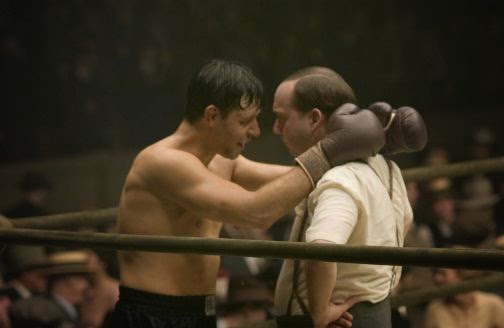
CINDERELLA MAN
Buoyed by great performances and Academy Award nom for Giamatti
MY TAKE: One of my 2-3 favorite films of all time (the other 2 are Shawshank Redemption and Crash).  I love this movie for so many reasons.  It will make you feel.

SYNOPSIS: Based on the true story of fighter Jim Braddock, who in Depression-era New York enters the boxing ring out of desperation to feed his family. He becomes a common folk hero as he battles his way up the ranks, vaulting from broken-down ex-boxer to living legend with a string of amazing upsets to his credit. As word of the scrappy underdog spreads, entire families stay glued to their radios, cheering, praying and experiencing his victories as their own. Their devotion reaches fever pitch when Braddock faces heavyweight champ Max Baer. That night, Braddock's dignity, courage and determination gives hope to a nation and earns him the nickname of Cinderella Man.

WHY YOU SHOULD WATCH THIS: You don't have to like boxing, nor be a fan of Russell Crowe or Renee Zellweger.  This movie is about choosing to get back up after getting knocked down (no matter how many times you hit the mat).  Boxing may be a perfect analogy for life in the courage to get back up off the mat when life is punching you in the face.  Give in to this movie.

QUOTE I LOVE"For two hundred and fifty dollars I would fight your wife... and your grandmother, at the same time." 


UNBREAKABLE: THE WESTERN STATES 100
http://www.ws100film.com/
Photo by Luis Escobar, RD of Born to Run Ultras and Red Rock
MY TAKE: This is JB Benna's masterful weaving of a story about living outside the box, challenging one's perceived limits and going into that unknown void and seeing what part of you comes back from it.  This movie inspires me for many different reasons.

SYNOPSIS: This is the story of the 2010 competitive men's race in the granddaddy of trail ultra runs, the Western States 100.  In addition to following 4 of the top ultra runners in the world, it tells much of the story of how the Western States Endurance Run came into being.

WHY YOU SHOULD WATCH THIS: Because everyone faces their mental breaking point in a race that means a lot to us.  Sometimes our expectations, our goals, or even the conditions in the race can break us.  Sometimes it's our competition.  But watch how these competitors respond to being broken, and what they do in the face of it.  Warning: it might make you want to run Western States, or 100 miles, or both.

QUOTE I LOVE"I can still take one more step. And so at that point I decided to take one more step until I could not longer take one more step." 


HONORABLE MENTION - Other Films I Love for the Mental Game
The Fighter, Finding Nemo, Rocky, 300, Rocky IV, and many more...


THE BOTTOM LINE
We could all use a little (more) work on our mental game.  These 6 movie-films will help you with that (and I threw in 5 more on the HM list a few sentences above this).  Hope you enjoy them as much as I do.  Let me know what you think, especially if you see them now (with new perspective).


If you have other films you love watching, post a comment below and let us know what films help you with your mental game!

Monday, January 27, 2014

Overemphasis on Training in 100 Mile Trail Run Prep - Angeles Crest 100 Lessons 2006-2014

"Nothing on Earth can stop the man with the right mental attitude from achieving his goal; nothing on Earth can help the man with the wrong mental attitude."
-Thomas Jefferson


BAD ATTITUDE 101 - Angeles Crest 2006 at Eagle's Roost
I am not the most qualified person to be telling you how to train for a 100 mile mountain race.  I am not fast, and am lucky to crack the Top 25 of a deep race field.  I don't even log high mileage all that often (number of weeks in 2013 over 70 miles = 6, number of 100+ mile weeks not including a week with a 100 mile race in 2013 = 0).  I have even coached runners for Angeles Crest (and various other 100 milers) that have failed to finish their respective races (don't ask about my Dave 'Comet' Chan story, please).  There are many more qualified AC experts out there.

All that aside, you have found this blog entry (so pull up a chair and stay a moment).  I'm here to present a perspective that I've been chewing on for a few years now, something I've struggled to fully grasp or articulate, but it crystallized in a conversation with a fellow student of 100 milers, and someone far more credible than I (who will likely blog on this very topic in the near future *nudge, nudge* ).

Okay, I lied, look how pretty I am here.
Running 100 miles (or "migrating 100 miles", to quote my fellow blogger Ashley) in a single day is a brutal challenge.  It tests us physically and psychologically, sometimes to the very fabric of our being.  It strips us of all excess energy, to the point where all facades fall away and we're left raw and emotive, just a primal being often going off of pure grit and gut instinct.  In my case this is often not a pretty sight.  For some of my closest friends it is a time to fully enjoy the show, as I behave in ways I might not want to be seen behaving at any other time (at least publicly).  I might throw a tantrum or two. I sometimes complain. I often puke. Sometimes I even cry like a baby.  And hold on to your seat for this one, there are instances I am dead quiet for extended periods of time.  *GASP!*

Chamoun leads Gleason up Williamson - AC 2012
I'd estimate in all of the training programs I've personally executed over the last 12 years preparing for marathons and longer races, my two most dedicated, high mileage, most focused training programs were in 2006 training for my first Angeles Crest 100 Miler and in 2008/2009 training for the Western States 100.  Interestingly enough, until I tried to run my 2nd hundred miler in a 2 week period (AC/Leadville back-to-back in 2013), both AC '06 and States '09 were my two most difficult 100 milers (see: most frequent low points, most death marching, and highest cumulative time in aid stations).  I don't care if you finish these races in 18 hours (or faster) or 30 hours, to me, speed is relative and it is an impressive feat of courage (and foolishness) to even toe the line of one of these monster mountain endurance runs.  Conversely, two races I probably had the least consistent training for, AC '13 and Rocky Raccoon '10, I had some of my better times.  Yes, those are wildly different events. I suffered tremendously at AC last year due to my lack of training (and other influencing factors), but I ran times I consider to be good for me at those two events (with less than ideal training).  This had me examining some of the finer points of 100 mile race prep with many friends of mine who have a depth of personal experience at 100 miles.  Leading up to a conversation between Pam, Kate and I, about interesting and notable performances on less than ideal training earlier this week.


As far as I'm concerned, this hypothesis could apply to the Pam Smith's (see: runners who win races) just as much as it does athletes who are fighting cutoffs for a high percentage of the race, and everyone in between.  Granted, the athlete who has less than ideal training might not be competitive for a win in today's deeper fields of competitors since most elites I've read up on now consider every element of what I'm about to talk to you about.

DISCLAIMER: I do not intend to insinuate that an athlete does not have to train very much to finish a 100 mile race.  Training up to this distance is essential.  Doing so intelligently, patiently (over an extended period of time), and consistently over race specific terrain is ideal.  The goal should be arriving at the starting line healthy, rather than "how many times can I run 100 miles in my weekly training" no matter the consequences.

HYPOTHESIS:  a great many athletes, especially first timers, place a dramatic overemphasis on training in prep for a 100 mile mountain race

To say this another way: many of us focus so much on cumulative weekly miles, running fast, running up steep terrain, tempo runs, speed work, stair repeats, strength training and getting physically ready that we overlook some pretty essential aspects of 100 mile racing (not to say we're all racing, but 100 miles in an event is distinct from just going out to do 100 miles on your own with no time constraints).

What often gets overlooked when training is overemphasized:
Checklists of everything I could possibly anticipate: AC 2012 edition
*Nutrition - both day-to-day diet influencing metabolic efficiency and effective race day nutrition strategies
*Mental Strategies - conditioning ourselves to think in a way that empowers and inspires our best effort, learning to deal with the inevitable and often devastating lows of a 100 mile run.  This can include mantras, anticipation of difficulty and acceptance of certain problematic scenarios.
*Hydration/Electrolyte Replenishment - there are many schools of thought here, but often athletes don't even consider how little (or how much) they're drinking or how an electrolyte imbalance might affect their race
*Pacing Plan vs Exertion Plan - you might think to yourself here, "nope, I always have a pacing plan" and that's one of my key points: we are often more focused on some target race time than actually adjusting to the effort/exertion level that is appropriate at that moment based on the signals our body is sending us, which can be greatly affected by conditions (heat, altitude, wind, terrain, humidity, etc.).  This doesn't just mean running too fast, it's sometimes being too conservative.
*Attitude - I hold this one slightly distinct from "mental strategies" although it is closely related.  A positive mentality can sometimes help us look at the same (sometimes ugly) circumstances and instead of panicking or having an emotional breakdown, we can smile and laugh about it.

"Do as I say, not as I do." -  IPA & a donut???
I'm the last person who can tell you what you should be doing for nutrition, but for many athletes, it seems to be almost an afterthought.  Fueling strategies implemented on race day aren't tried-and-true for most.  Sometimes, athletes that have something they've practiced a ton in training goes haywire on race day because of aid station grazing (those candies and cookies look great, I'll have a couple).

Hydration and electrolyte replacement is really personal.  There are some diametrically opposed schools of thought here on how much one should drink and whether one should supplement with electrolytes or not.  Again, if you've given no thought to it, it's just guesswork.  It's amazing that so many athletes spend a year planning to run 100 miles, pouring hours into physical training each week, many more hours just thinking about it, without consideration for anything specific here.

Pacing plans: here's the thing, if you are seeking to finish your first 100 mile race, finishing will be a PR.  Some athletes get so caught up in buckling, going for sub-24's, and completely ignoring the redline signals because of pace splits for a goal time that they sacrifice the finish.  And it has proven to be a grotesque oxymoron for me (and dozens of the athletes I train) that when I focus on everything but my splits, I run my fastest time.  When I focus on my time splits, I fall off them pretty quickly and then have to deal with my negative emotions around that early failure.

"Attitude is a little thing that makes a big difference."
-Winston Churchill


Hurting: Mile 52 at AC in 2011. Attitude shift necessary.
Attitude/Mentality: I remember a few years back being too sick to start the Lake Sonoma 50 Miler, on race day I ended up working race check in and helping build the finish line area.  I got to cheer a few Coyotes and a few other friends across the finish line.  I remember one girl in particular who finished mid-pack and threw a tantrum to her friends, "That was the worst day of my life!" she sobbed.  I sat there awestruck.  Wait, didn't you just finish 50 miles?  What about the people still out there, behind you?  What about the people who DNF'd today?  I will never know this girl's name, but she taught me an amazing lesson that day: embrace the hurt locker.  I went on to Angeles Crest that summer (four months later) and every time I felt miserable, I thought to myself "I'm still moving forward at a decent clip, it could be worse, I'm so grateful to be out here doing this..." and it changed my race.  Without very much race specific training that summer, I ran my fastest AC100 time.  A huge part of that was my perspective shifting.  I put a lot of thought into it beforehand.  How am I going to feel out there?  Probably pretty crappy at some point, but that's what I signed up for.

In summary, there are so many pieces to traveling 100 miles on foot, in a single go.  Training may be a key piece of that, but if you don't consider every other piece, you might just be throwing a lot of that training down the drain.

Another parting shot, a clip of the conversation between Pam, Kate and I:
Pam - "So, how fast do you have to run to go sub-24 in 100 miles?"
JDF - "You gotta run 12-13 minute miles, depending on how much time is wasted in aid. Overall 14:30-ish average."
Pam - "Right. So really, how fit does one have to be to maintain 12-13 minute pace?"
JDF - "Depends on the course, I guess?"
Pam - "Sure, but don't you think it's not often the pace that sabotages one's sub-24 goal, but rather, poor nutrition plans, sour stomachs, and not being ready for the low points (mentally)?"
JDF - "Interesting point, Pam..."
Mr. & Mrs. Smith (photobomb by yours truly)
There's a good chance you'll see Pam on the starting line at Angeles Crest this year with a personal vendetta against AC.  I met Pam in 2010 at AC, at Mile 42.  She was trying to drop out and her husband Mac persuaded me to convince Pam to continue.  So she dropped out at the first aid station that was crew inaccessible.  Coincidentally, it was the aid station where I branded myself with my first ever DNF too, Mile 49, the Mt. Hillyer checkpoint.  Whether there in 2014 or not, I'm betting on Pam to finish her next AC...

My Angeles Crest 100 History in finishing (or DNF) photos:


2006 - Finish, 26:27
2007 - DNF at Mile 49

2011 - Finish,   23:51  (first AC silver)

2012 - Finish, 22:38
2013 - Finish, 23:39
2014 - ????
No idea what this year holds in store, but I know Angeles Crest will hypothetically be my 4th 100 mile race inside of 2 months (June 7 - August 2).  I'm ready to be schooled again by one of my favorite mountain ranges anywhere... and I'll be hitting the starting line leaving no stone unturned...

Monday, January 13, 2014

Meeting My Maker on a Sunday Night - My Aron Ralston Near Miss

"The word adventure has gotten overused. For me, when everything goes wrong, that’s when adventure starts."
-Yvon Chouinard

I am so glad you are reading this blog entry.  Let me rephrase that, I am so glad I am sitting at my computer on a Monday and am not presently buried beneath dense foliage in a ravine with a broken leg, or worse.  It was a rough night, last night...
NOT A THROUGH TRAIL - that sign is for other people... not for me!
I've been running my whole life.  I have come to develop an identity problem which is to say, I can't imagine myself not running.  I can't even imagine identifying as something else.  My wife Kate is struggling with that identity challenge right now (she broke her right leg and had surgery in November), and I'm doing all I can to support her emotionally and physically through it (stopping just short of running way less myself so she's not confronted by that reality).  It is one of the greatest challenges we've yet faced as a couple.  Sometimes we're both worn down emotionally, and we get into a fight over absolutely nothing (bear with me, this sets something else up).  We have recently fought over navigation, missing part of a hockey game, leaving the house on time, and an online GoPro order.  Seriously folks, these fights might have had a deep undercurrent of something else, but they were fights about absolutely nothing of substance.  Nothing essential, nor important.  The last two fights we had were back-to-back nights (Friday & Saturday) and combine with that my not running nor working out since Thursday, come Sunday I was in a bad, overly emotional, and mentally dark place.

So I went out for a run Sunday mid afternoon.  I didn't know how far or for how long I'd be gone, but I knew I needed something long to clear my head.
Backbone Trail selfie, almost one of my last photos...
***FLASHBACK***
Last bit of sunlight fades away... this is getting interesting.
It's around 4:45pm, Sunday, January 12, 2014.  The sun has long since disappeared over Temescal Ridge & Cathedral Rock, and I'm buried in a canyon in the Santa Monica Mountains, part of the north splintering of Rustic Canyon.  I have taken a horribly wrong turn.  Wandering up a creek bed I thought was part of the old (and heavily overgrown) Bay Tree Trail, I got stuck where landslides have boxed the creek in, so I start to climb out & around it.  I find myself on the side of a crumbling rocky hillside utilizing plants & branches to not fall down the steep slope.  At one point, every brittle, dry piece of chaparral is breaking off in my hands, no matter how thick or deeply rooted it seemed.  The rock starts to crumble under my trail shoes and I notice that there's nothing to catch my fall before about a 4-story (60 foot?) drop into the rocky creek bed below.  Looking off into the distance, I'm probably 3/4's of a mile from any real trail.  I don't have my cell phone.  I don't have a light.  Nobody knows where I am.  "Genius, Jimmy! Absolute genius,"  I say to myself.  My last bit of ambient daylight is fading like a K-mart beach towel.  I feel the hair on the back of my neck stand up.  I must start carefully calculating every movement, and at the same time, if I stay in the same spot too long, the hill will crumble beneath my 180+ lbs. and give way to big air.  I force myself to keep moving and mentally brace myself for the worst.

Trying not to achieve a similar fate, unsettling at best.
Thankfully, I'm not panicking, but I am acutely aware that if I fall, I'm very likely going to be too injured to crawl out, in a place inhabited by at least one mountain lion (I've discovered lion scat and deer skat on the game trail I'm now crawling up to get to the ridge).  After crawling sideways and upwards for at least 45 minutes, breaking branches to climb towards the ridge line, I end up in a clearing (relief).  With two large sets of bones (relief just left the building).

"When I've lost my way or when I am confused about a path to take, I remember that most answers I need I already possess – deep inside. I am naturally creative, resourceful and whole. If I consult my invisible compass, I’ll know what to do."
-Steve Goodier

Estimated route = GREEN / Incidents = YELLOW
The sun is now gone but atop this ridge I'm getting a little light from a relatively full moon (full moon is 3 days later).  I start to realize crawling through this game trail at dusk (in darkness) probably isn't a great strategy anymore.  I can see the lights of the San Fernando Valley about 1.5 to 2 miles to the north, but would have to drop into another canyon/ravine to get there.  I resolve to keep climbing and to stay standing as much as I can to avoid looking like the prey of a cougar.  I climb through multiple brier patches and stop occasionally to pick a half dozen to dozen thorns out of my hands.  I'm still not panicking, but I'm wondering if I should hunker down and wait for daylight.  I have half a bottle of water left, a 200 calorie granola bar, and my legs are starting to cramp from the fatigue of forcefully climbing through (and over) dense vegetation.  After what seems like 2 hours, but is probably in reality 75-90 minutes of dusk, I reach the ridge line above Fire Road 30 (a single track trail we jokingly call Flyer Road 30), one of my favorite lesser known paths in the Santa Monica Mountains.  I am overcome with emotion.  Not really joy, but rather, a profound relief that I'm not hurt, and I'm not spending the night facing the fears I was just crawling out of a canyon with.  I dump the rocks and dirt out of both shoes and start to piece together how I'm going to get home.  At the very least, I feel safe again.
***END FLASHBACK***
First photo after crawling out of the unknown.

Looking homeless, dirty, cut & bruised.
I have always had a rule to not drink when I'm upset, angry or depressed.  I have a new rule now to not go trail exploring when in that same space.  When I went running yesterday, I didn't know where I was going to go.  I didn't know for how long, nor how far I was going to run.  As I ran up Sullivan Ridge, I made up my mind to do a loop that dropped into Murphy's Ranch, climbed J-Drop then the section of the Backbone Trail known as Rogers Road, take Temescal Ridge to the Hub Junction, drop down Fire Road 30 to Bent Arrow connecting to Dirt Mulholland, then run that to Sullivan Ridge, and drop back down to my car.  I estimate this loop to be something between 15-18 miles.  When I reached the upper part of Rogers Road, there's a drop down trail back into Rustic Canyon called Bay Tree.  I've always wanted to explore it, and know 2-3 people who have.  I thought, "I know there will be some bushwhacking, I know there's not much daylight left, but what the hell, it's only a couple of miles!"  I had a secondary intuitive sense that said, "this is gonna be an adventure" and I thought, "hell yeah, I'm ready for an adventure!"

My skin is gashed and bruised all over, this is one small sample.
This was the part where I greatly erred.  I ignored my intuition which said, "this is shaping up to be a bad idea.  Ooh, sounds like a fun bad idea!"

RULES I ALREADY KNEW (AND PREACH)
*Whenever possible, don't run trails alone
*When running alone, let someone know your planned route
*Have a planned route
*Carry a cell phone, in case you get stuck and need to alert someone
*Carry a light if there's any possibility of getting lost or running after dark
*Carry more than adequate fluid & calories in case you get lost
*If you get to an impassable patch of trail/creek bed, turn around and retrace your steps, don't be a hero
*Let someone know your planned route (restated for it's importance)
*Help others learn from your most boneheaded mistakes (check)

A NEW RULE
*Just like drinking: when you are upset, don't go seeking "adventure" on the trails, just go run a super intense speed workout on a track or treadmill or something like that

GENERAL LIFE SIDE NOTE
Consider for a moment the last thing you said to your loved ones.  Would you be okay with that message if it was the last you ever delivered to them?  One of the things that haunted me, maybe what I was afraid of the most out there, was if the last things Kate & I said to each other (prior to my misadventure) were etched into eternity as the final exchange we had.  I got home and we immediately put it all behind us.  You have an opportunity to say things to the people you love, from love, each and every time you're with them.  I encourage you to utilize every opportunity to do that.  For your own sake.

Thanks for reading this.  I appreciate you (even if we don't know each other), no matter where you stand.  One more parting thought:

"If you can't be a good example, you'll just have to serve as a horrible warning."